Study Skills for Success: Time Management
Have you ever sat down at your desk ready to study, open your books, and immediately become overwhelmed at how far behind you feel? Me too!
This all too familiar feeling is hard to overcome and can be a huge roadblock when it comes to studying effectively, but rest assured that there are ways to navigate this daunting task. Found below are some of my favourite and most effective study tips that I have personally achieved study success with. If you find one you like, don’t be afraid to give it a try and if it doesn’t work for you, that’s ok! There are plenty of methods out there and only you know what’s best for you.
The Pomodoro Technique
I’m sure you’ve all heard of the pomodoro technique before or at least some version of it. For those that don’t know, this method uses a cyclical approach to alternate between studying and resting at frequent intervals to keep the mind fresh and engaged. To use this technique, pick your topic to study whether it’s a section, textbook chapter, lecture notes, slides, etc. and set a timer for 25 minutes. Until the timer is up, your only focus is the topic you have selected, no phones, no screens (unless you are studying on a computer/laptop), no food, nothing but you and the content. The goal is to eliminate all distractions and fully immerse yourself in the content. Once the timer goes, take 5 minutes to stand up, walk around, use the bathroom, make a tea, whatever you need to do. After those 5 minutes, set another 25-minute timer and just as before, get back into it! Depending on your style and how fast you are moving through the content, you may want to take a longer break after a certain number of cycles. Experts recommend that every fourth break be a bit longer (15-30 minutes). The constant cycling between studying and resting allows you to avoid burnout by giving time for you to step away from the content for a bit before returning while also providing time and space for you to be focused on the content and only the content.

Finding it hard to remain focused for 25 minutes? Some students opt to make this into a mini challenge with themselves. Every time you become distracted whether it’s a phone notification, email, message, a bird flying by, anything, you reset the timer and start again. On the other hand, some may prefer to shorten the cycles to 20 minutes of studying and 5 minutes of resting or even 15 minutes of studying and 2 minutes of resting. It all comes down to preference and what works best for you!
Breaking Down Projects Into Smaller Tasks
While in school, I often found myself not taking advantage of the time in between classes and those awkward 30- or 45-minutes breaks between commitments. This resulted in an immense amount of time being wasted over the course of the semester. It wasn’t until my final year when I really understood what it meant to break down bigger projects into smaller tasks. I struggled to realize that you can, at any moment, pull out your laptop on campus and complete a task. I felt that all studying and schoolwork had to be completed at a desk whether it was in the library, or at home.
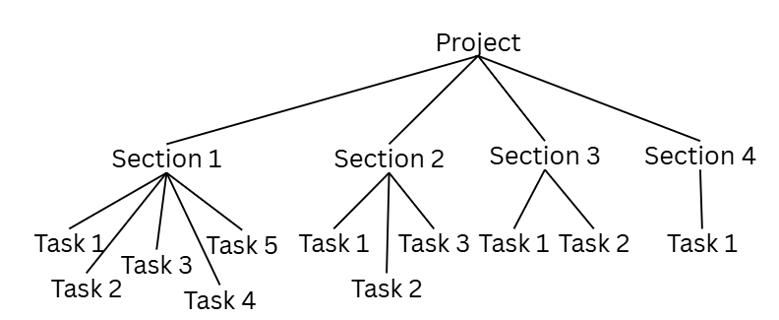
Breaking down larger projects or tasks into smaller, more digestible individual tasks isn’t hard, but does require some degree of critical thinking and you can really take it as far as you want. Say you have a big group project to work on, you may opt to break it into four parts, leaving one part per group member, or break it down even further into individual tasks. Regardless of your groupmates, taking your tasks and breaking them down can help take that wasted time and turn it into results. Let’s start with some examples.
Let’s say you have a calculus worksheet due tomorrow morning. Rather than waiting until you are home for the evening to complete it all in one sitting, make each question on the worksheet an individual task. If each question takes 5 minutes, it will feel a lot more approachable than if you were to complete all the questions in one sitting. With a worksheet, the professor has made the task division quite easy whether you choose to do it by question, or in sections. Let’s look at a more complex example.
Let’s say you just got out of your business class and have a huge marketing project due next week that includes an audio-visual presentation. This already seems overwhelming and it’s only an example! The first thing to do is take a deep breath and explore how you can break this down to make it more manageable. Considering there is a presentation component, we could break it down in the following manner:
Select topic or subject of the presentation
Preliminary research and learning more about the topic
Further, more targeted research, gathering materials for the presentation
Slideshow development
Speaking points or speaker notes (whichever you prefer)
Polishing and finishing touches
This breakdown turns a daunting project into individual tasks that can be completed one-by-one. If you would like, you can even break it down further to make it even easier but be cautious with going too deep as the more steps you add, the more overwhelming it can get! The best part of this method is that you can complete these individual tasks whenever, wherever and can even be combined with other methods to achieve an even higher level of efficiency. Furthermore, this breakdown method even gives you a bit of an idea of your timeline. Seeing as the presentation is due next week, we can do one task everyday and still have some time to practice and perfect our presentation. I love this method because of how easy it can make big projects but I prefer to combine it with this next method to make things run smoother and even easier!
The Dreaded (but useful) To-Do List
I can’t tell you how many times my academic advisors told me to make a to-do list so I can stay on top of all the deadlines, assignments, projects, and everything else in my life. Honestly, I never took a to-do list seriously until I learned how to effectively use one. Before this, it was just a dumb piece of paper that I would look at every time I reached into my fridge but never checked, checked off, and eventually just threw out. The true power of the to-do list came for me when I discovered Microsoft To Do. Having my to-do list in a digital format not only made it easy to access on all my devices, but made it easy to consistently add things and check them off. Having this integrated into my outlook email kept me on top of assignments and provided constant reminders of my upcoming deadlines and tasks. The beauty of the system is that your list exists everywhere, on my phone, my laptop, my desktop, my email, it’s literally everywhere. Now I know this seems scary, but for me I needed that constant reminder to get my stuff done in time and this might be the best method if you are like me. If there’s one piece of advice I can give you about the to-do list, it’s this; the list is only effective as long as you look at it. The moment you stop looking, is the exact moment it stops working and that is exactly why having it everywhere I looked worked so well, because it served as a constant reminder.
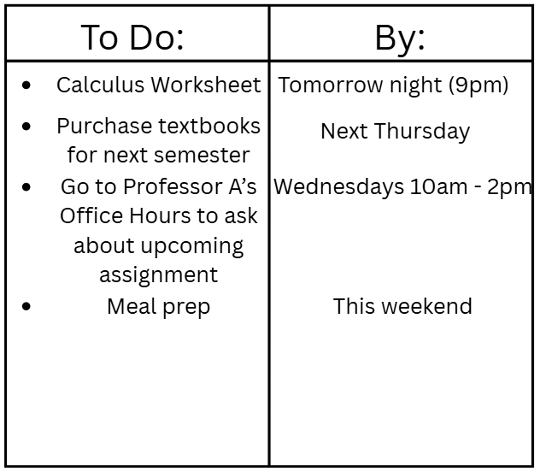
To level-up your to-do list, I suggest adding dates or times to the items so you have a better idea of the timeline you’re working with. For example, instead of having “call the dentist” on my to-do list, I’ll write “call the dentist on Monday before 4pm – set appointment for next Wednesday”. Adding the extra detail gives me a better idea of what exactly needs to be accomplished and for those who are a bit forgetful like myself, can help keep you on track!
If you’re interested, check out this article on how to get the most out of Microsoft To Do.
The 168-Hour Week
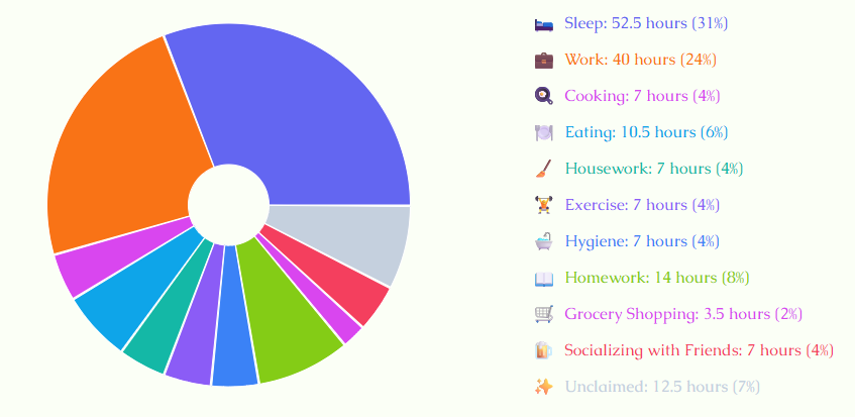
The 168-hour week is a bit of an odd tool and I wouldn’t say it’s the best for daily time management but for me it really changed how I viewed my time and time management as a whole. There are a couple different ways to complete the task whether it’s on paper, in a worksheet, or at this nifty website, but regardless, the goal is the same, to look at and review how you spend every hour in your week. Like I said, this method isn’t going to miraculously make you twice as efficient, but it can bring a fresh new perspective to how you see time management and can prevent you from wasting your own time!
After completing this task, I found myself trying to take advantage of every minute of the day and when combined with some of the other methods I’ve mentioned, that’s when I really hit my stride. Seeing just how much free time you really have is enlightening but don’t take it for granted and start wasting your time!
Closing Remarks
At the end of the day, it comes down to what works best for you. You don’t have to be the best right now but a step forward is a step in the right direction and there’s not better time than now to start. Take a look at some of these methods and start experimenting, there’s no pressure to stick with anything but give it a fair shot and see what you like. Some methods require a bit more effort, and others might come easier, it’s all about making the most out of your time!