Rewriting the mental health conversation on campus
TL; DR
Mental health stigma is still common on campus, and it often shows up as people saying “I’m fine” when they’re not. Improving mental health literacy starts with closing the gap between what we feel and what we say. Mental health exists on a spectrum, from healthy to reacting to injured to ill. Recognizing early signs makes it easier to get support before things worsen. Silence and fear of judgment keep people from speaking up, but open, honest conversations can reduce stigma and help others feel less alone. Small actions like checking in with yourself and others, being honest, and encouraging professional support when needed, can gradually shift campus culture toward one where mental health is normalized and openly discussed.
The Things We Don’t Say: Rewriting the Mental Health Conversation on Campus
In today’s post-secondary world, there still exists a stigma around mental health and well being. It’s a concept not spoken about often enough, yet still manages to impact each and everyone of us, whether you know it or not. The aim of this article is to rewrite the conversation about mental health and well being, opening the discussion and saying the things we haven’t been saying. Before we talk about the changes we can make to our own conversations, we first need to evaluate why these changes are needed, and what the current conversation looks like.
The “I’m fine” Culture
As with any significant venture in life, there is a degree of emotional commitment and consequently, emotional consequences. For many, going through post-secondary is a life-changing experience with heavy emotional influences that sometimes we don’t entirely understand or don’t have the tools to process. We get bogged down with assignments, exams, group projects, and a hundred other things that all need to be finished by the end of the day. We simply don’t have time to sit and process and we end up telling ourselves and those around us “I’m fine.” In reality, things might not be fine but we as humans also don’t like to burden others with our problems, further pushing us from accepting and embracing help in favour of some façade that makes it seem like we have it all together. This part of the conversation really needs to start inside, recognizing when we need help. Note here, you don’t have to be hurt or in pain to get help, mental health often doesn’t show physically in the early stages of decline, making it important to constantly and consistently check-in with yourself and ask “how am I really doing?”
Identifying and eliminating the gap between what we feel and what we say is the first step to moving forward in a more conscious manner that fosters good mental health and well being. The second step is to then practice asking for help and understanding what help might look like given our current circumstances. When we are experiencing intense emotions that are causing significant distress in our lives, it might be time to visit the on-campus counsellor. On the other hand, when we notice we’re doing ok but start having feelings, that might be a good time to try some mindfulness practices or engage with some resources that help with getting our mental health back on the right track. There are plenty of helpful resources available online and on-campus, so take a look around and see what interests you!
Mental Health is a Spectrum
Most folks can fairly easily recognize when their mental health is in a poor state, but our goal is to make sure we catch ourselves before we get to that state. To better understand what this looks like, imagine your mental health exists on a spectrum ranging from healthy to ill. In between these two extremes, we have the reacting stage and the injured stage. When we are healthy, we are doing well, there are no issues and our stressors are being managed. In this stage, we don’t need to spend much effort on making sure we stay here, but it’s always good to practice mindfulness anyways. The next stage is reacting; this is the stage when we first start to see a decline in our mental health. Here, we might notice that we’re not doing quite as well as before, we might be starting to feel more tired, irritable, or nervous, as well as decreased social activity, procrastination, and physical changes such as weight gain, sleeping patterns, and eating patterns. It’s best to catch our mental health when we are in this state before it falls any further. Let’s say things keep trending in the same direction and we fall into the injured stage. This stage is where you may feel angry, anxious, or sad, you may have a negative attitude and be more withdrawn from social activities. During this stage, you might also notice poor hygiene and increased alcohol and substance usage. If things were to continue trending even further, we would reach the ill stage, where we are easily enraged, have excessive anxiety, or even a depressed mood. In this stage, you might also recognize thoughts of suicide, and inability to concentrate, total social withdrawal, and addiction. This is the final stage of the spectrum and we really want to make sure we are getting help before we get to this stage. With all this in mind, mental health is on a spectrum that flows. During the student life cycle, you’ll likely see yourself move around from healthy to reacting, maybe down to injured, and then back up to reacting and healthy. It’s important to understand that mental health is fluid and it is NOT a one-way road! When we notice we start trending in the wrong direction, that’s when it’s time to reach out for help and take a look at the supports around us. Before you keep reading, take a minute to check-in with yourself. What stage are you in right now? What signs do you notice that makes you think you are in that stage? What are some things we can do right now to help our mental health?
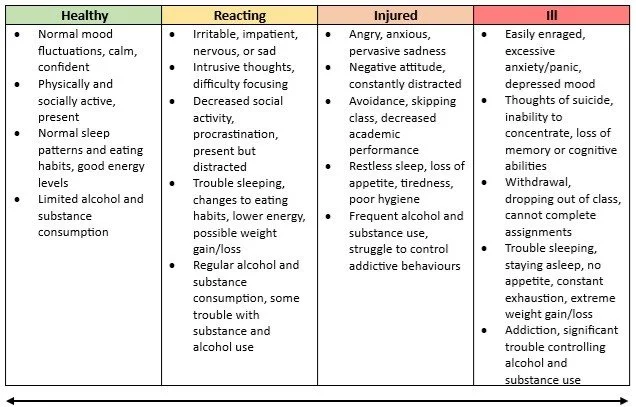
Mental Health Continuum
Checkout the full mental health continuum tool from the Mental Health Commission of Canada here.
The Silence Problem
In post-secondary, the stigma surrounding mental health still largely exists because of the attitudes we hold and how mental health is viewed in our society. Unfortunately, staying silent about the issues we are facing, only lets them grow inside us and does not help advance the conversation and how people view mental health. People experiencing mental health issues or challenges might choose to keep silent for many different reasons. For some, they might not want to be seen as “weak” or don’t want to make the conversation about themselves because “others have it worse.” This internal self-doubt only makes things worse and prevents people with mental health challenges from seeking the supports and resources they need.
By opening the conversation and asking the tough questions about someone’s mental health, we can show that we are open to discussing it and helping them work through what they have going on, or getting them connected to supports and resources. Next time you’re with your friends, take a minute and really check-in with them, ask how they are doing and show that you are open to discussing mental health.
From Conversation to Support
Showing our friends and family that we are open to discussing mental health greatly contributes to eliminating the stigma surrounding mental health however, we also need to understand the limits of what we can and cannot do. When we notice our friends or ourselves starting to enter the injured or ill stage, that’s when we need to seriously start considering professional help if not already in use. When we notice our friends or ourselves in the reacting stage, we can occasionally handle this on our own, not by acting as a therapist or counsellor, but by taking advantage of the resources and supports available to us. Take a minute to check out your school’s website and see what resources are available to you. Most post-secondary institutions will have on-campus counselling available to students as well as countless resources in the surrounding community. Note here, that attending counselling for the first time is a scary and daunting task that can discourage people from going. If you have a friend that is thinking of going but has some hesitation, this might be a chance for you to walk to the office with them, or provide that sense of comfort and safety in some other way. By bringing counselling and therapy to the discussion, supporters can also help normalize this aspect of the conversation, further eliminating the stigma.
Change Starts Small
Changing the campus culture and erasing the stigma is a slow process and it won’t happen overnight. Fortunately, every small moment can be a step in the right direction. Remember, opening the conversation requires effort from both parties, from supporters to start the conversation and show they are open, and from those with mental health challenges to be brave, overcome the feelings of self-doubt and stigma, and share their honest truth.
By: Matthew Schmidt